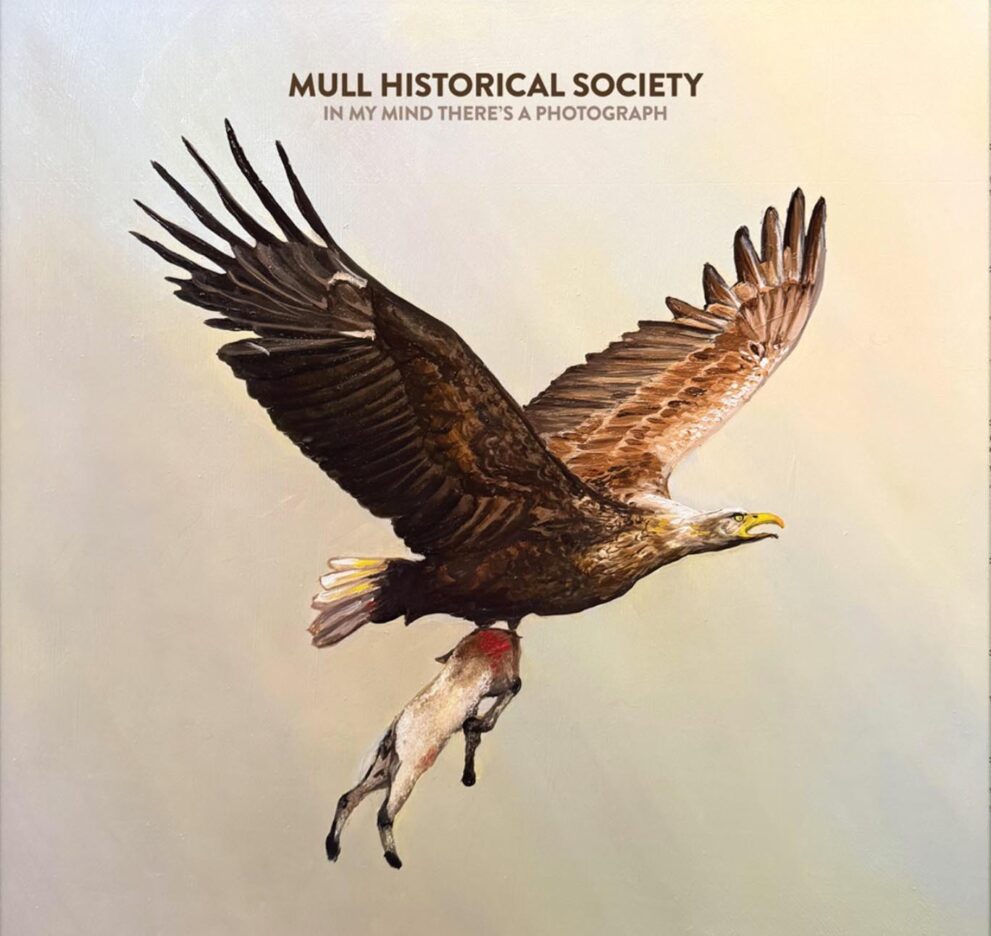
For Mull Historical Society’s last album, Colin MacIntyre — who is, in essence, Mull Historical Society — invited acclaimed authors to write lyrics for his musical compositions. The result was 2023’s In My Mind There’s a Room, a record featuring contributions from writers including Nick Hornby, Jacqueline Wilson and Alan Warner.
Warner’s involvement felt especially poignant, not only because he is an admirer of MacIntyre’s work as both musician and novelist, but because of his affection for MacIntyre’s grandfather Angus’s poetry anthology, Ceilidh Collection.
Three years on, MacIntyre has returned to that collaborative world, but with a different starting point. This time, he asked a new group of authors to provide photographs and descriptive imagery, which became the inspiration for twelve new songs. Traditionally, MacIntyre’s writing has drawn deeply from his upbringing, family history and roots on the Isle of Mull. With In My Mind There’s a Photograph, however, he broadens the frame, using other people’s images and memories to move far beyond the island while still retaining his own emotional fingerprint.
The album opens strongly with “Where Are the Heroes?”, inspired by Dan Richards’ grandfather, who worked nights on postal trains. It arrives with a catchy, energy-filled rock sound that gives the record an immediate lift and offers an early point of connection for the listener.
“Once Upon A Tightrope” begins as a tender, almost tear-stained piece before developing into something more layered, fusing melancholy with jangly, distorted rock textures. The image of the tightrope is especially moving, connected to Colum McCann’s father-in-law and his walk from his desk in the collapsing second tower to safety on 9/11 — little over a month before Mull Historical Society released their debut album, Loss.
“Cattle of Bells” quickly moves the listener away from the horror of 9/11 and towards the Botswana border of the Kalahari Desert, drawing on memories from Alexander McCall Smith’s youth. It is followed by “Charing Cross Canyon”, inspired by crime writer Louise Welsh’s photograph of the construction of Glasgow’s Charing Cross. Here, MacIntyre explores the human cost of so-called progress — homes disturbed, lives displaced — with the song’s extended, dreamlike piano outro giving the piece a quietly euphoric sense of reflection.
From Botswana and Glasgow, the album later travels to China on “We Called It a Lake”, where Chinese-American Pulitzer Prize winner Yiyun Li’s photograph of her childhood accordion band opens a window onto her former daily life. Elsewhere, “Budapest” is one of the record’s more haunting moments, its slow, echoing piano beautifully capturing Irenosen Okojie’s memories of the city, her seizures, and her sisterly connection to that place.
A bright, innocent, family-friendly pop song might not be the first sound that comes to mind when thinking about the echoes of a grandparent’s now-empty home, but MacIntyre makes it work beautifully on “Your House Was Aglow”, doing justice to the image provided by author Paul Lynch. The album then closes with “Hillman Imp”, a song that celebrates Highland culture and takes inspiration from a newspaper photograph of Ali Smith’s mother and sister sitting in their car.
In My Mind There’s a Photograph once again proves MacIntyre’s gift for creating something emotionally resonant from a shared theme. These are not straightforward collaborations in the usual musical sense; they are conversations between songs, images, memories and writers. That MacIntyre continues to invite authors rather than musicians into his process says a lot about his curiosity and willingness to be challenged.
The Isle of Mull and the Highlands remain central to his creative identity, but here they are not boundaries. They are the home base from which the album looks outward. Through these photographs and the lives behind them, MacIntyre builds a thoughtful, heartfelt record about memory, place and the strange power of an image to unlock a song.

Be the first to comment