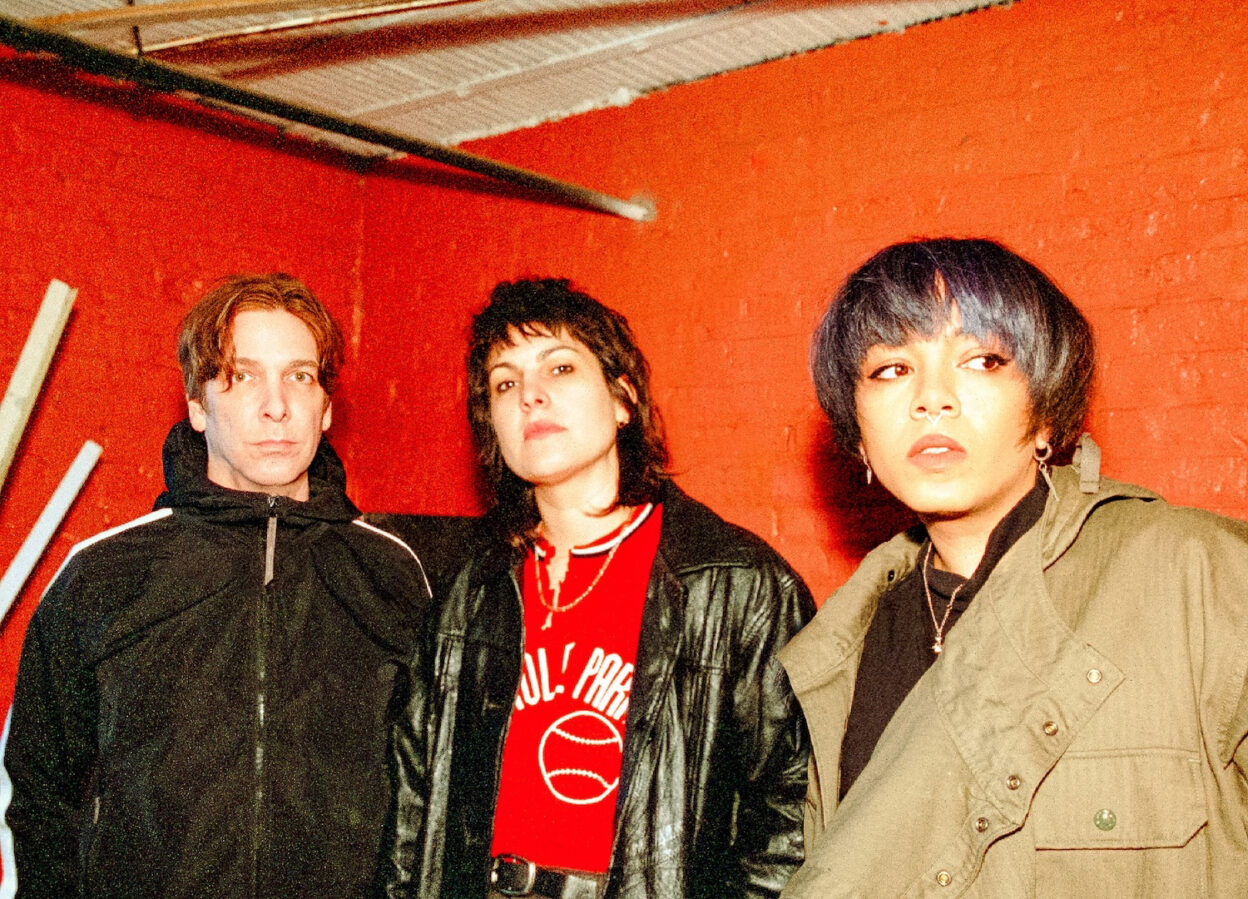
Chicago’s underground has always thrived in the margins, and few bands embody that restless, art-driven spirit quite like Ganser. Formed in the city’s DIY circuit, the group have carved out a reputation for wiry, confrontational post-punk/art-rock that favours tension over release. Across their three albums — Odd Talk (2018), Just Look At That Sky (2020), and their latest, Animal Hospital (2025) — Ganser have steadily refined a sound that feels as informed by art school theory as it does by noise and rhythm.
At the centre of it all is bassist, vocalist and co-founder Alicia Gaines, who arrived in Chicago two decades ago via what she describes as a “back door” into music — initially moving to the city for art school, and not necessarily to start a band. That outsider perspective still defines Ganser’s approach: curious, angular, and difficult to categorise. It’s a balance she continues to maintain, juggling band life alongside her work as a graphic designer and creative director, which feeds directly into the band’s visual identity as much as its sound.
With Animal Hospital marking a new chapter — and their first-ever tour of the UK and Europe — there’s a sense of a band stepping into a wider spotlight, one that Alicia is clearly excited to finally experience first-hand. As Alicia tells it, even the climate feels familiar: grey skies, rain, and something quietly intense beneath the surface.
I read that you were into drawing and painting well before music. Was that from an early age?
Alicia: College, but I did grow up with that. Some kids have soccer or ballet; mine was painting classes. I fell into that and did the classic “do the thing you’re best at”. I got into a good art school here in Chicago, and that’s kind of how I came up. I’m a graphic designer and creative director, so that’s kind of like that’s my intro into everything.
I was a big music head as a kid, too. I played classical and was in marching band, but that doesn’t necessarily mean you’re going to wind up in a garage in a rock band. I think I came in through the back door, so to speak, through loving album covers and that sort of thing.
It was all part of it, wasn’t it? I grew up with vinyl when the artwork was larger, well before the current revival. The music and the imagery felt connected. Plus, I’m a huge fan of a gatefold sleeve.
Alicia: Me too! I think when you’re a kid, you take it for granted. You look at a band like Devo and think that’s their “factory setting”. But as a creative director, it was fun to go to DIY shows in Chicago and realise: if the entire band decides to wear tinfoil, you can do whatever the hell you want.
What drew you further into music? You clearly loved graphic design and painting, so what changed?
Alicia: I grew up playing clarinet and piano, so I knew how to speak the language. I was working my first graphic design job where you’re very directed, you aren’t making the choices. I’d do that all day and the last thing I wanted to do was go home and pick up oil paints; it used the same muscle.
My boss had a Fender Jazz bass and I asked to borrow it. To get away from classical training, I started learning Pixies and Sonic Youth basslines by ear. Just “The Kims” – Kim Deal and Kim Gordon. Moving from design software to music software felt natural.
The band’s debut release was a two-track digital-only single — Smelling Salts and Losing Light — issued in July 2015. Released independently online, it captured the band’s early raw DIY sound. Neither track is available on streaming platforms or the band’s Bandcamp page. Do you ever go back to those early recordings?
Alicia: Wow, I haven’t heard those in at least five years. It’s crazy you tracked those down. We were working day jobs and doing this on the side. Losing Light was actually a reference to Nadia [Garofalo], who was in the band at the time and worked in film. “We’re losing the light” is a film phrase.
You were putting out releases almost every year right up to your second album in 2020. Were the creative juices just flowing at that point?
Alicia: Our first record, Odd Talk [2018], was recorded and mixed in five days. It was a “tear the Band-Aid off” moment. By the time we got to Just Look at That Sky [2020], we felt we had our arms around the process. We recorded it in 2019, planned to release it in April 2020…and then the world shut down. It gave me something to do while everyone was yelling at the sky on Twitter. Brian and I were sheltering in the same place, we had a drum kit and two laptops. That’s where Animal Hospital started. We then passed files to the other members.
Following the release of Nothing You Do Matters — a three-track EP released in October 2022 — co-founder Nadia Garofalo left the band soon after, marking a significant shift in the band’s identity. Guitarist Charlie Landsman also exited during the recording of Animal Hospital, further reshaping the group’s internal dynamic.
Alicia: Yeah, Nadia left in 2022. And then Charlie, he’s a bartender and he really got into the world of opening bars and choosing menus. He wanted to spend more time doing that. He’s actually on half of the recordings on the new record, but we brought in a new guitarist, Dove [Hollis]. Then Sophie [Sputnik] joined the band. They’re amazing and will be joining us in Europe.
Sophie joined after Nadia’s departure in 2022 and quickly became a central creative voice. How did Sophie come into the band?
Alicia: We were actually co-workers back in 2017. She moved up from Florida and had been a musician from the jump, the opposite of me. She’d been through the ringer, toured the country, the whole thing. She moved to Chicago asking, “What’s the scene like? Who are the bookers?” We both had our own bands then, so there was no thought of making music together until the transition. Then it was like, “Oh, Sophie’s a killer musician”. It’s funny because I think Dove and Sophie have been in the crowd at previous Ganser shows; they might even be in the videos.
A defining feature of Ganser is their use of dual vocalists, with Alicia handling about half the vocals. The contrast gives their songs a shifting, unpredictable edge. Their lyrics are also shared, pulled from a long-running archive of overheard lines and found fragments.
Alicia: I do just under half the vocals. I like having two vocalists; it’s like “salt or pepper” or “hot or cold.” It provides contrast. Plus, it’s two heads for lyrics. We’ve had a Google Doc that has existed for 10 years. If you hear someone say something crazy at a party, you write it down. Later, if you’re mumbling a melody, you go to the doc. A fair amount of our lyrics are things overheard at parties or read in Reddit comments.
A defining feature of Ganser is the use of dual vocalists, with you handling about half the vocals. How do you know who is right for each song?
Alicia: Sophie is a soprano and I’m an alto. Also, Sophie plays keyboard and guitar, but sometimes she plays nothing and runs around the stage with the microphone. If we want someone diving into the crowd, she sings it. If I’m anchored to the bass, I’ll do it from the centre.
On Animal Hospital, the drums feel noticeably more expansive and deliberate than on earlier records. Was that a conscious choice, and how did your approach to percussion evolve during the recording?
Alicia: We were experimenting with drums because of home recording. “Black Sand” has two layers of drums for a polyrhythm effect. I think bands like Gilla Band or Mandy, Indiana are pushing how far you can push analogue drums before adding electronic elements. Rock has been left in the dust a bit by other genres using trap hi-hats; we’re trying to bridge that gap.
The near back-to-back departures of two key members would have tested any band. Were there ever any thoughts of ending Ganser?
Alicia: Going on year ten, you realise bands either last two years or they get into this decade-long space. If we weren’t growing, it would be time to hang it up. But with the new members and new challenges, like having a tour manager and playing larger venues, it feels fresh. The past five years have given everyone a bit of a “fuck it” energy. This will be our first time in Europe and the UK, and we’ve been waiting for this for a decade.
It took five years to record and release Animal Hospital. What are your thoughts on it now, a year on?
Alicia: I’m very happy with it. We were folding in new people. For example, on the track “Dig Until I Reach the Moon”, I had written the strings, bass, and vocals, and then I just told Dove, “I want some guitar to dance on top of this”. Capturing that live in the studio was a fun moment. It’s another time capsule, but different from Odd Talk.
I have to ask about the track “Touch Sensitive”, the last song on Odd Talk. It’s a great and unusual track, and stands apart in Ganser’s catalogue as a rare detour into shoegaze territory. What can you tell me about that song?
Alicia: Yeah, that was unique. The influence was Sophie Scholl and the White Rose Rebellion against the Nazis. It’s an anti-fascist song, but we wanted to make something beautiful. I’m not a huge shoegaze head, but I like the ruckus of Ride and Swervedriver. Shoegaze gets boiled down to aesthetics now, which doesn’t give the genre enough credit. There is a white-hot intensity in it that I find beautiful and terrifying.
As mentioned earlier, by day, Alicia is a graphic designer, but she also shapes the band’s visual identity by hand-crafting each album cover. She translates their sound into something visual. When asked what fuels the creative process behind the iconic imagery for Animal Hospital, her response is surprisingly raw.
You’re also a graphic designer. What inspires you visually?
Alicia: Anxiety inspires me! I feel a responsibility to make sure the whole band likes the art. For Odd Talk, the type was ransom style from old magazines. For Just Look At That Sky, we wanted a warning, ergo yellow. For Animal Hospital, we were using cartoon motifs. Naturally, the most famous cartoon character is a rabbit.
The band has a pair of tracks that feel like mirror images: “YES NO” from Odd Talk and the bracketed “[NO YES]” from Just Look At That Sky. While the former features female vocals and the latter is led by a male vocal, the connection between these two titles seems intentional.
I couldn’t help but notice that you have a track called “YES NO” and then, on the follow-up album, “[NO YES]” with square brackets. Are those tracks connected?
Alicia: I’m glad you noticed the brackets! We just liked the way people say “No, yeah” or “Yeah, no.” “YES NO” started as a joke – like elevator music – and became a punk song. Then when we made an actual elevator track, we realised it reminded us of the first one, so we called it “[NO YES]”. We have little internal jokes like that.
One final question: for people who aren’t familiar with Ganser, which five songs would you say best represent the band?
Alicia: First thought, best thought:
1. Pastel
2. Black Sand
3. Half Plastic
4. Emergency Equipment and Exits
5. Lucky
Ganser tour the UK and Europe from May 18 to 22.
Follow Ganser here: Ganser Linktree
Be the first to comment