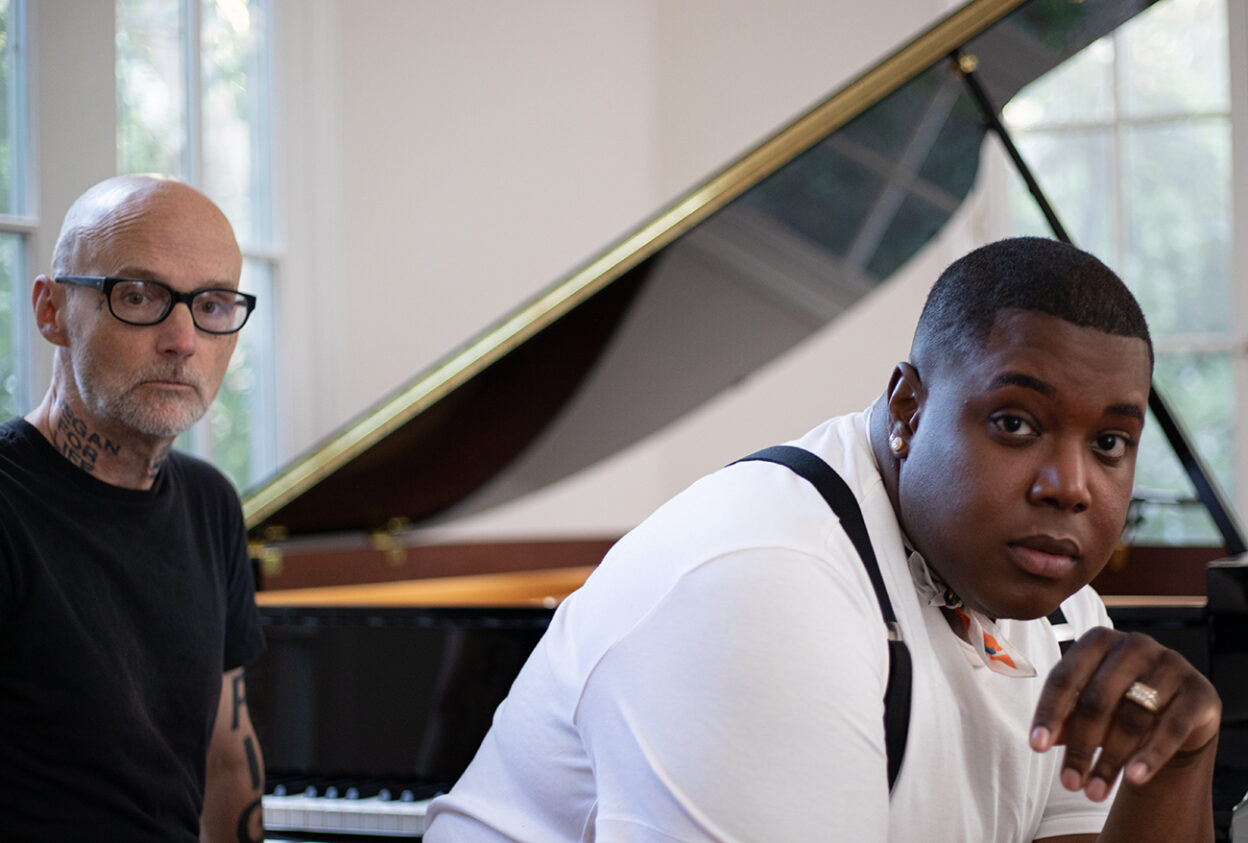
Moby announces his 23rd studio album Future Quiet, to be released on February 20th 2026 via BMG and shares the lead track, a new version of the Stranger Things hit “When It’s Cold I’d Like To Die” featuring Jacob Lusk, best known for his work with the acclaimed Gabriels.
Future Quiet signals a striking new chapter for one of electronic music’s most enduring and visionary artists. Across eleven tracks that encompass modern piano minimalism, immersive ambient soundscapes and a smattering of vocal collaborations, the album finds Moby reflecting on the tension between hyper-connected modern life and the deep human need for stillness.
Elaborating, Moby says, “‘Future Quiet’ is, not surprisingly, quiet. To be clear; I love bombast. I love excess and volume. But as the world gets louder and crazier I find myself needing the refuge of quiet, both as a listener and as a musician. For me, and hopefully for others, ‘Future Quiet’ is a refuge. The world, self-evidently, is more demanding than it’s ever been. The world screams at us, our screens scream at us, other people scream at us, and to retreat from the screaming we need safety and refuge. That for me is the goal of ‘Future Quiet’. Writing and recording it was a refuge for me, and I hope that listening to it is a refuge for you.”
Listen to “When It’s Cold I’d Like To Die” (ft. Jacob Lusk) BELOW:
The album opens with a stunning new orchestral reworking of “When It’s Cold I’d Like To Die,” featuring the glorious Jacob Lusk on vocals. “I first heard Jacob’s voice on KCRW when they started playing ‘Love and Hate in A Different Time’,” Moby recalls. “And, like anyone who’s heard Jacob sing, I immediately fell in love with his voice. After hearing him sing on the radio, I spent weeks tracking him down and begging him to work with me. And, lucky me, he agreed. The results speak for themselves, as his vocals on ‘When It’s Cold I’d Like To Die’ are, I say with something approaching objectivity, transcendent.”
The original song (featuring vocalist Mimi Goese) was first released on Moby’s 1995 album Everything Is Wrong. The track has gained a new generation of listeners thanks to its emotive use in seasons one and four of Netflix phenomenon Stranger Things. Clamour for the 1995 song amidst the fifth and final season of Stranger Things has seen it leap to Moby’s most streamed song as well as go viral across TikTok. Speaking of its success, Moby says, “It’s reaching hundreds of millions of people annually, which is both wonderful and surprising, especially as it was an obscure song with no drums or bass and was never released as a single.”
Over more than three decades, Moby has cemented his music icon status.
A multi-platinum-selling, multi-award-winning singer, songwriter, producer, author, filmmaker and animal rights activist. He released his first single, “Go,” in 1991 (listed as one of Rolling Stone magazine’s best records of all time), and has since sold over 20,000,000 albums worldwide. His groundbreaking approach and musical innovation reshaped electronic music, defined a global sound and continues to influence producers, composers and artists across generations. Moby has produced and remixed artists as varied and disparate as David Bowie, Public Enemy, Ozzy Osbourne, The Beastie Boys, and Daft Punk, to name a few, and his most recent collaborations on his label Always Centred At Night focused on new and established powerful voices including Lady Blackbird, Benjamin Zephaniah, serpentwithfeet, José James and Akemi Fox. The last year has also seen him work with Russian ambient music prodigy Øneheart, plus remixes from Silver Panda, BLOND:ISH, DJ Tennis, Kiko Franco, Airrica and Kilimanjaro, released on Defected and Mute. His unwavering musical curiosity has taken him from rave-era techno to ambient, orchestral, acoustic and experimental work. His work reflects a constantly evolving artist, securing ongoing relevance in an ever-changing cultural landscape.
“When I was growing up I played in hardcore punk rock bands, and I DJed VERY LOUD hip hop and house music and industrial music,” Moby says, “but I also needed the refuge of quiet records like This Mortal Coil, The Cocteau Twins, Eno & Bowie’s ambient music, Gorecki, Arvo Part, etc. ‘Future Quiet’ is definitely the product of my influences, as I can’t count the number of times I’ve listened to ‘Song to the Siren’ or Joy Division’s ‘Atmosphere.’”
A vocal and longtime advocate for animal rights, environmental issues and mental health awareness, Moby consistently uses his platform to champion compassion and sustainability, often donating proceeds and visibility to causes rather than commercial ventures. This ethos has earned him a reputation as an artist whose work is inseparable from his values.
Moby’s influence extends well beyond music. His books, essays, photography and collaborations across film, dance and visual art reveal a depth and introspection rare amongst global artists. His openness about recovery, vulnerability and personal reinvention has made him both relatable and enduring, solidifying his presence as a cultural force who combines innovation, longevity, activism and emotional depth in a way almost no one else does.
Moby’s plans for 2026 reaffirm why he remains one of the most singular and influential artists of our times, whose work continues to shape the emotional and cultural fabric of modern life.
This year will see Moby embark on his biggest tour in a decade including a Coachella festival appearance. He is set to perform at On The Beach in Brighton, UK on July 26th, with full UK tour details to be announced soon.

TRACKLISTING:
When It’s Cold, I’d Like To Die (ft. Jacob Lusk)
This Was Never Meant For Us
Retreat
LiEstrella Del Mar (ft. Elise Serenelle)
Ruhe
Mott St 1992
Precious Mind (ft. India Carney)
Tallinn
On Air (ft. serpentwithfeet)
Selene
La Vide
Great Absence
Mono No Aware
The Opposite of Fear


Be the first to comment