
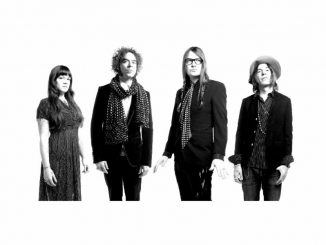
There’s long been a subtle rebellious streak at the core of The Dandy Warhols. Since emerging from Portland in 1994, they’ve approached genres as something fluid rather than fixed, and Pin Ups – their 2026 covers collection – slides effortlessly into that approach.
Borrowing its title from Bowie’s 1973 covers album might suggest reverence, but this is anything but a straight homage. In true Dandys fashion, these 17 tracks are less covers and more sonic rewrites, refracted through their hazy, neo-psychedelic lens. Long time fans will know this isn’t new territory. The band have spent years peppering their catalogue with covers – on b-sides, tribute records, and live sets – pulling from a deep well that includes everyone from post-punk pioneers to classic rock staples. Pin Ups simply gathers that spirit into one cohesive, sprawling statement.
Standout moments arrive early. “What We All Want”, originally by Gang Of Four, is retooled into something even more wiry and propulsive than the 1981 post-punk original. Likewise, “Primary”, originally by The Cure, is stripped back and rebuilt with a woozy, hypnotic groove that feels distinctly Dandy Warhols.
The Cult get a double nod with “Rain” and “She Sells Sanctuary”, an inclusion that makes perfect sense given the band’s long-standing affinity for that brand of gothic-tinged classic rock. Both tracks shimmer with reverb-drenched guitars and a laid-back cool that never slips into imitation.
Zia McCabe steals the spotlight on “Kiss Off”, the album’s lead single. Her vocal turn on the Violent Femmes classic injects a fresh, playful energy, making it one of the record’s most immediate highlights. Elsewhere, “Straight To Hell” (The Clash) drifts into an depunkified dreamy, almost narcotic state, while “Beautiful People” flips expectations entirely – Marilyn Manson’s industrial snarl replaced by Courtney Taylor-Taylor’s falsetto, transforming menace into something strangely elegant.
Perhaps the boldest reinvention comes with “Love Song” (The Damned), reimagined as an electronic pulse that would leave its punk origins barely recognisable. Even “Blackbird” is treated with care, retaining its intimacy while subtly reshaped in the band’s image.
Pin Ups works because it never tries to outdo the originals. Instead, it filters them through decades of Dandy Warhols DNA, and the result is a collection that feels both reverent and refreshingly off-kilter.


Be the first to comment