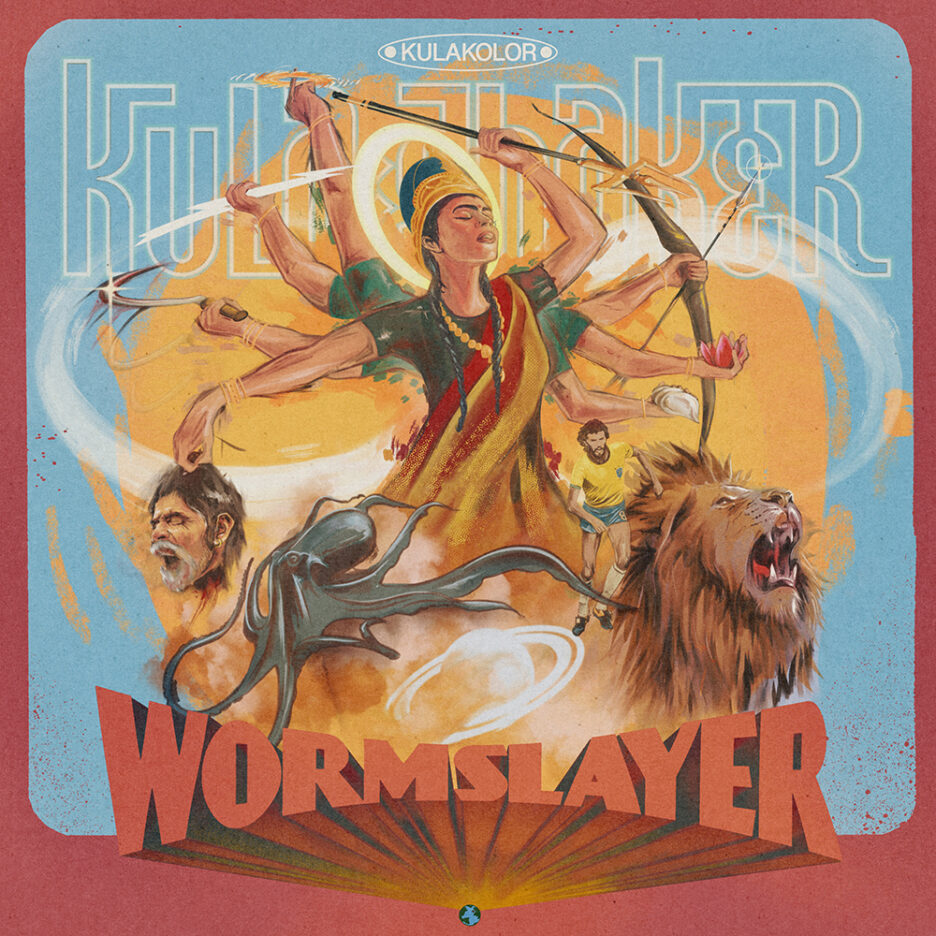
Kula Shaker have never been a band in a hurry. Their history is dotted with long gaps between albums, sometimes stretching close to a decade. Since 2022’s 1st Congregational Church Of Eternal Love And Free Hugs, though, that pattern has shifted. Wormslayer arrives as part of a welcome run of more regular releases and feels like a confident continuation rather than a reset.
The album draws heavily on the mysticism and psychedelia that defined their earlier work, particularly Peasants, Pigs & Astronauts, but it doesn’t sound stuck in the past. Instead, it refines and expands on familiar ideas, mixing spiritual themes with playful experimentation and moments of real emotional weight.
Opening track “Lucky Number” sets the tone. It starts in a hazy psychedelic space before tipping into glam rock, all without losing the band’s identity. Lyrically, it reflects on gratitude, purpose, and meaning, using recurring numerical imagery along the way — including a neat self-reference to “33 Crows” from K 2.0. It’s thoughtful rather than showy, and it rewards a close listen.
Elsewhere, Wormslayer isn’t afraid to step outside Kula Shaker’s usual sixties-inspired framework. “Good Money” blends psychedelia with early-nineties dance and acid influences, delivering a political message that feels measured rather than preachy. “Little Darling” goes the other way entirely — a light, doo-wop-styled track that recalls The Four Seasons, with a faint echo of The Animals’ “House of the Rising Sun”.
The album’s emotional core comes with “Shaunie”. Written from the perspective of a worn-down circus performer, it’s understated but deeply affecting. Crispian Mills’ delivery of lines like “circus freak, they paid to watch you weep” and “a thousand times, you broke my heart”, supported by Crosby, Stills, Nash & Young-style harmonies, gives the song a quiet, lingering sadness.
“Charge of the Light Brigade”, the album’s first single, takes its name from the 1854 poem by Alfred, Lord Tennyson. Its lyric “they’re breaking the law, these masters of war” is a clear nod to Bob Dylan’s “Masters of War” — a connection made more fitting given Mills’ history of covering the track with The Jeevas.
Some of the album’s strongest moments come from its extended instrumental openings. “Broke as Folk” slowly unfolds before settling into warm, melodic territory reminiscent of The Mamas & the Papas, with hints of the old-English textures the band have explored before. “The Winged Boy” opens in a more abstract, drifting way, eventually revealing itself as one of the album’s most grounded and quietly beautiful tracks. The title track, “Wormslayer”, stretches past seven minutes, moving from an Eastern-influenced soundscape into full psychedelic rock as guitars and organ take over.
“Be Merciful”, written over twenty years ago, finally feels complete here. Its themes of vulnerability and being led astray remain powerful, now enhanced by Eastern-styled instrumentation and choral textures. “Day for Night”, at just seventy-nine seconds, is brief but effective — a gentle, soothing pause before the closing stretch. The album ends with “Dust Beneath Our Feet”, a blues-leaning, folk-tinged track that sounds surprisingly upbeat despite its ominous lyrics.
Unlike Natural Magick, Wormslayer isn’t built around obvious singles. It’s an album that asks for time and attention. Some tracks take a few listens to fully open up, but the payoff is worth it. This is a thoughtful, confident record from a band still following its own instincts — and doing so with conviction rather than nostalgia.




Be the first to comment